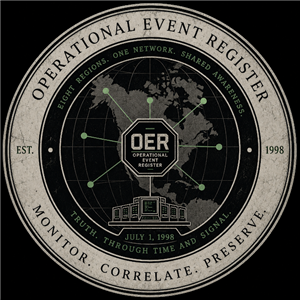
Operational Event Register
System Overview
The Operational Event Register, or OER, was established to consolidate operational information from multiple sources into a common monitoring and reporting environment.
Designed to support situational awareness across interconnected systems, OER collected incoming information, maintained operational records, and supported the identification of relationships between events that might otherwise appear unrelated.
Its central function was correlation. Individual incidents could be recorded and evaluated within a broader operational context, allowing developing patterns and potential relationships to be examined across sources, locations, and reporting periods.
OER was built on the principle that an event's significance may not be immediately apparent when considered in isolation.
Origins
OER originated from work conducted under Project NEXUS, an earlier systems initiative focused on integrating information from distributed sources.
NEXUS established the technical foundation for the system's data integration, information handling, and correlation capabilities. As development progressed toward operational service, that foundation evolved into a dedicated monitoring and reporting environment.
OER was formally commissioned on 1 July 1998, establishing a centralized system for the collection, consolidation, and correlation of operational information.
Although OER became a distinct operational system, its underlying architecture retained elements of the work that preceded it.
System Architecture
The original OER architecture consisted of OER Central and eight regional nodes.
OER Central served as the primary coordination and correlation environment. It consolidated information from regional sources, maintained the broader operational picture, and provided a common point from which incoming events could be evaluated in relation to one another.
The eight regional nodes provided the distributed component of the architecture. Their role was to support the collection and transmission of regional information, extending the system's visibility beyond a single location or reporting environment.
This arrangement allowed OER to operate across multiple sources while retaining a centralized view of reported events.
The architecture also introduced an ongoing operational dependency: the quality and continuity of the central picture relied on the availability, connectivity, and integrity of the systems and sources contributing to it.
Operational Function
OER was designed to support several interconnected functions:
- EVENT MONITORING: Collecting and maintaining information about reported operational events.
- DATA INTEGRATION: Bringing information from separate sources into a common environment.
- EVENT CORRELATION: Identifying potential relationships between incidents across sources and time.
- OPERATIONAL AWARENESS: Providing a consolidated view of developing conditions.
- RECORD PRESERVATION: Retaining information for subsequent review, comparison, and historical analysis.
These functions were intended to complement one another. Monitoring provided the incoming information; integration established a common context; correlation helped identify relationships; and record preservation allowed those relationships to be examined beyond the immediate reporting period.
The resulting operational picture was dependent on the information available to the system. Missing data, delayed reporting, incompatible sources, and interruptions in regional connectivity could affect the completeness of that picture.
Operational History
OER's continued operation required more than maintaining its central systems. Its effectiveness depended on the supporting infrastructure, regional reporting capabilities, data interfaces, communications paths, and technical processes that connected its components.
Over an extended operational lifespan, these dependencies required ongoing maintenance and adjustment. Interfaces needed to remain compatible, data integrity required verification, and the system's records depended on the continued availability of the sources from which they were assembled.
As with other distributed information systems, individual components could remain functional even when the wider environment supporting them became less complete.
The distinction between a functioning component and a fully functioning system remained an important consideration in assessing OER's operational state.
Archival Status
The surviving OER record is incomplete.
Gaps in historical documentation and variations in the availability of surviving information limit the extent to which every period of operation can be reconstructed with certainty.
The absence of a record does not necessarily establish that an event did not occur. Similarly, the continued presence of a system component or surviving record does not, by itself, establish the condition of the wider architecture.
Historical information must therefore be considered in the context of its source, continuity, and known limitations.
This profile summarizes the system's intended purpose and original architecture. It does not constitute a complete operational history.
Legacy and Continuity
OER was designed to identify relationships between events across distributed information sources and preserve an operational picture that could not be obtained from any single source alone.
Its underlying challenge remains relevant wherever interconnected systems must be monitored, separate streams of information must be evaluated together, and developing conditions must be understood across time.
The original architecture, commissioning records, and surviving technical documentation remain useful references for understanding the system's design and intended function.
OER // OPERATIONAL EVENT REGISTER
COMMISSIONED 01 JULY 1998